
Costa Rica is home to an astonishing array of life. Some 500,000 species have already been described by science.
However, there are a handful of species that steal the heart of any traveller that ventures to Costa Rica: monkeys!
In Costa Rica, you can find four different species of monkey: Capuchin, Howler, Squirrel and Spider monkeys.
Capuchin monkeys are perhaps the most common species, found in both natural and disturbed regions throughout Costa Rica. The squirrel monkey is the rarest, found in just a few National Parks.
During my time in Costa Rica, I have had the privilege of not only seeing monkeys in their natural habitat, but also working with all four species in a captive setting.
This three-part blog series will explore the different monkeys of Costa Rica, the threats they’re facing and my work with them. This first blog will look at the monkeys, and their life-histories, of Costa Rica.
What (Exactly) Is A Monkey?
It’s not a trick question. I know most of us have probably seen a monkey – be it in a zoo, on tv or even in the wild.
But what is a monkey?
A monkey is a generic term used to describe approximately 200 species of primate. Although closely related, they are not the same as apes.
Most monkeys are arboreal and can be found in tropical forests – Costa Rican species are no exception.
Besides a few species of night monkeys, most species are diurnal, meaning they are active during the day. They use their four limbs, as well as their tails, to move around the trees in search of food, such as leaves, fruits, nuts, eggs and invertebrates.
Many species of monkeys have a long, prehensile tail. They use these tails to help support their weight whilst swinging through the canopy, as well as for balance.
Like humans, monkeys are highly dexterous. Both their hands and feet are used for grasping and manipulating objects, such as food items or branches.
Again, similar to humans, monkeys have large brains and are remarkably intelligent. Many species, most notably capuchins, have been known to use tools to aid in complex cognitive tasks – something I have witnessed first-hand.
So, now that we’ve briefly explored what makes a monkey a monkey, let’s discover the monkey species found in Costa Rica.
Monkeys of Costa Rica
1. White-Faced Capuchin Monkey
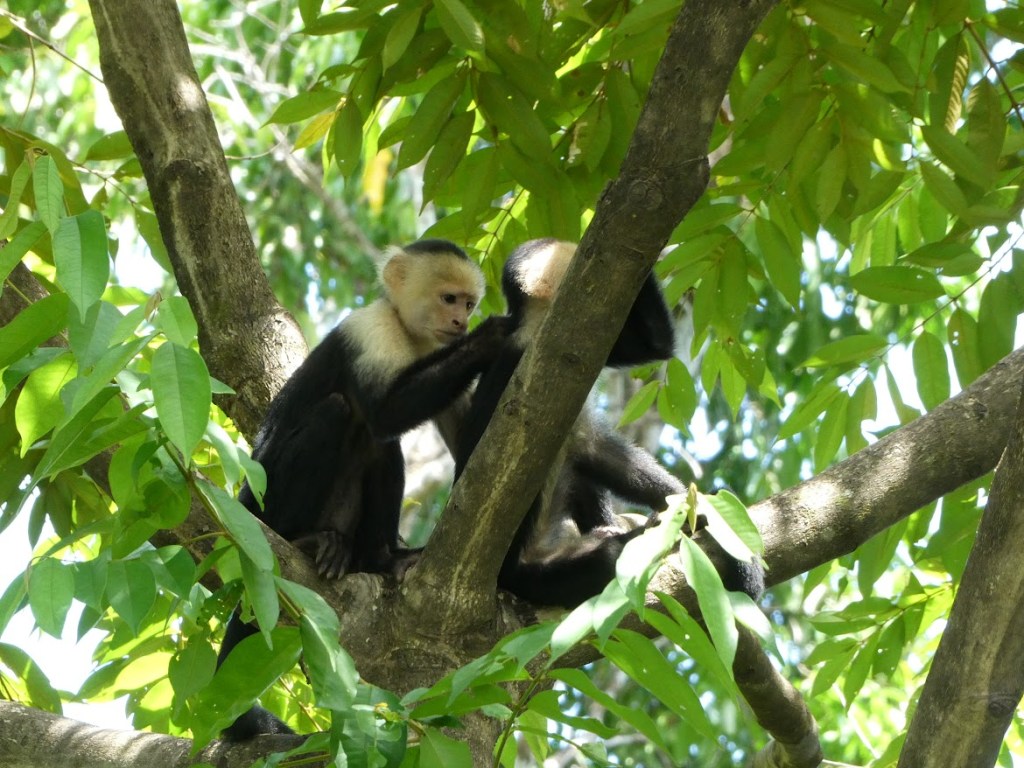
Of the 5 species of capuchin monkeys distributed throughout Central and South America, only one species can be found in Costa Rica: the white-faced capuchin.
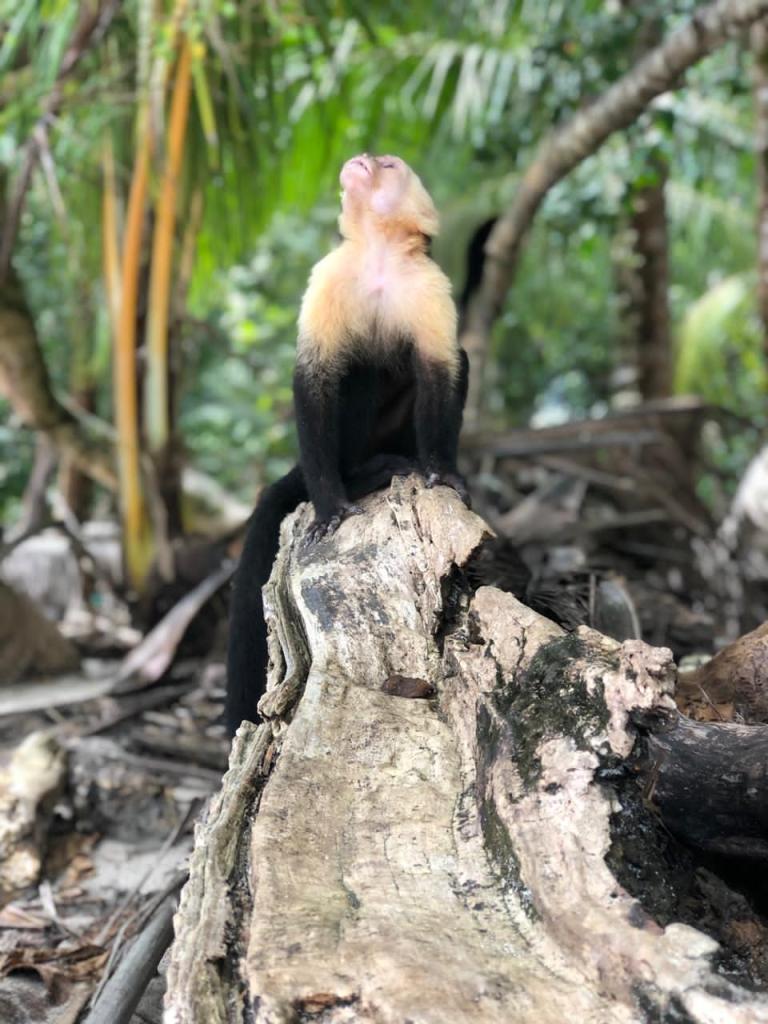
Weighing around 4 kg, this medium-sized monkey can be found across much of Costa Rica. Their distinctive black fur is broken up by white fur on the front part of its body and a pinkish, hairless face.
They are an adaptable species, found in a variety of habitat types. Capuchins occupy coastal habitats, dry forests, primary and secondary rainforests and volcanic foothills, such as Arenal Volcano.
For a capuchin, anything is on the menu. Whilst the majority of their diet comprises fruits and nuts, at least 20% of their diet is derived from animal protein. This includes eggs and insects, to small vertebrates such as birds, squirrels and lizards.
White-faced capuchins are highly social and playful animals. They live in mixed groups, with females remaining in the same group their entire lives, whilst males leave to find mating opportunities.
I have a great deal of love and respect for capuchin monkeys. I am always amazed with how clever and intuitive they are. Every week, whilst working at a rescue center, I would create and offer various enrichment puzzles for our resident capuchins to play with. They are a joy to watch.
2. Howler Monkey
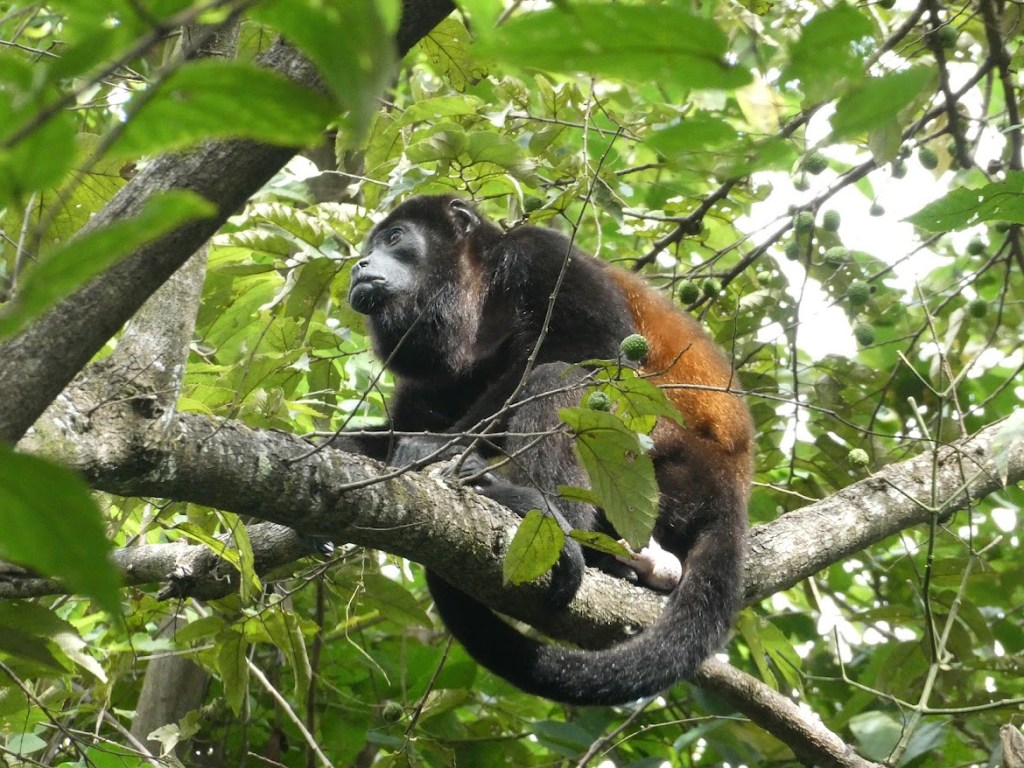
Unlike capuchin monkeys, which are highly active and energetic, howler monkeys are a lot more reserved and slow moving – despite being one of the largest primate species in Costa Rica. This is partly due to their folivore (leaves) diet.
However, what they lack in energy, they certainly make up for in vocalisations.
Male howler monkeys are loud. Really loud.
In fact, they are often considered one of the loudest animals on planet Earth – they aren’t called howler monkeys for no reason.
But what makes howler monkeys so loud?
Well, it’s all to do with the hyoid bone.
Whilst most mammals have a hyoid bone, the hyoid bone of howlers have evolved to become rounded and shell-like, enabling sound to be amplified.
The roar of a male howler monkey can be heard up to 5km away. That’s nearly 50 football fields stretched out. All the whilst being surrounded in thick, sound-proofing jungles. Pretty impressive.
Ok, so we know how they make such a loud noise. But why are howler monkeys so loud?
There are three theories as to why howler monkeys howl:
1. Dominance – A male needs to be louder than his rivals and competitors to be heard.
2. Mate attraction – The louder the roar, the better the health. A desirable trait for interested females.
3. Territory – The louder the roar, the more likely other males will stay clear of his territory.
If you have never heard the roar of a howler monkey, it can be really quite unnerving.
My first ever experience of a howler monkey roar was back in 2018. I was conducting research on sea turtles and had to cross a stretch of mangrove forest to reach the beach.
At just past 4am, before the sun had risen, a deafening roar resonated around me. To say the use of profanities was used was an understatement. I thought a jaguar was out to get me.
Fortunately, I survived to tell the tale..
If you have any similar stories of your first wild animal encounters, drop a message in the comments below.
3. Geoffroy’s Spider Monkey
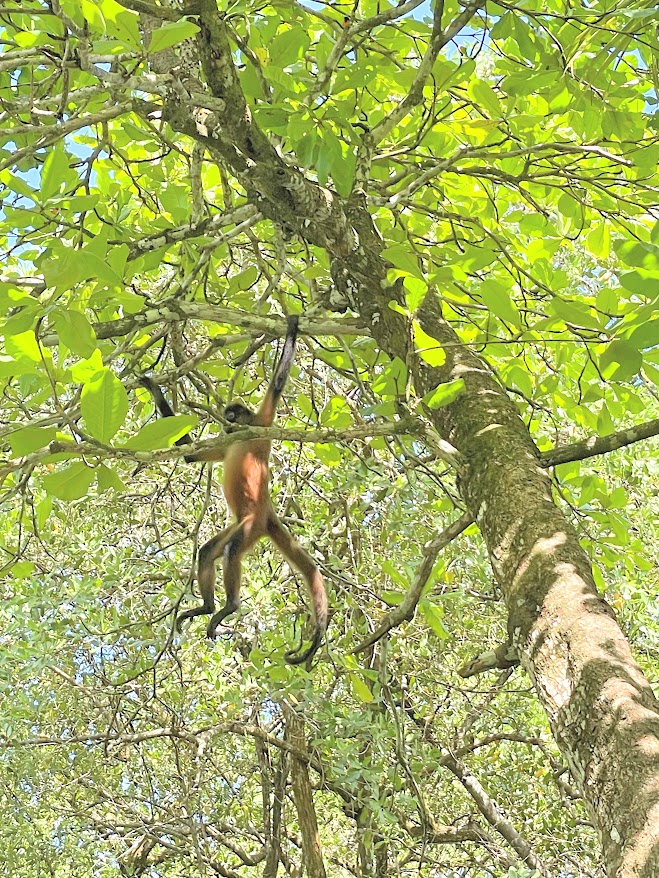
Alongside the howler monkey, spider monkeys are one of the largest primates to be found in the New World, weighing as much as 9 kg.
The name spider monkey refers to their long, gangly limbs, which are thought to resemble those of a spider. Personally, I don’t see it. For starters, a spider has 8 limbs, not 4…
Whatever the origin of their name, one thing is for certain; Geoffroy’s spider monkeys are adapted to life in the trees – perhaps more so than any other Costa Rican monkey.
Their long arms and legs aid in brachiation – a fancy science term meaning to swing from tree to tree. By swinging through the branches, spider monkeys are able to cover large distances.
Not only do they use their arms to swing, but they also use their tail as an extra limb. This muscular appendage is incredibly long and powerful, fully able to support the entire body weight of a spider monkey. This comes in handy for when spider monkeys want to use their hands to forage.
Like the capuchin monkey, the diet of a Geoffrey’s spider monkey is omnivorous. They frequently eat fruit and leaves, however, protein is occasionally supplemented in the form of insects and eggs.
At the rescue centre where I worked, we had a troop of spider monkeys. And there was one thing that always caught my attention – their genitalia.
Hear me out.
In spider monkeys, size does matter. At least, for females.
Females have an engorged clitoris that dangles down – much like the flaccid penis of a male. Except, the genitalia of the female is normally larger than that of the males.
Scientists that study primates, referred to as primatologists, suggest the large sex organs are key in mate selection. The larger, more engorged the clitoris is, the more sexually receptive a female is.
After a potential mate is selected, males will start touching the clitoris.
However, this is not an act of sexual pleasure. Instead, the male can pick up on olfactory cues, ultimately gauging a female’s sexual receptiveness. He does this by sniffing his fingers after touching the clitoris.
Each to their own, I guess.
In Costa Rica, spider monkeys are considered endangered. According to the International Primate Society, they are thought to be one of the world’s 25 most endangered primates. This is because they need large areas of primary rainforest to forage. A habitat which is very much under threat from deforestation and habitat loss.
4. Central American Squirrel Monkey
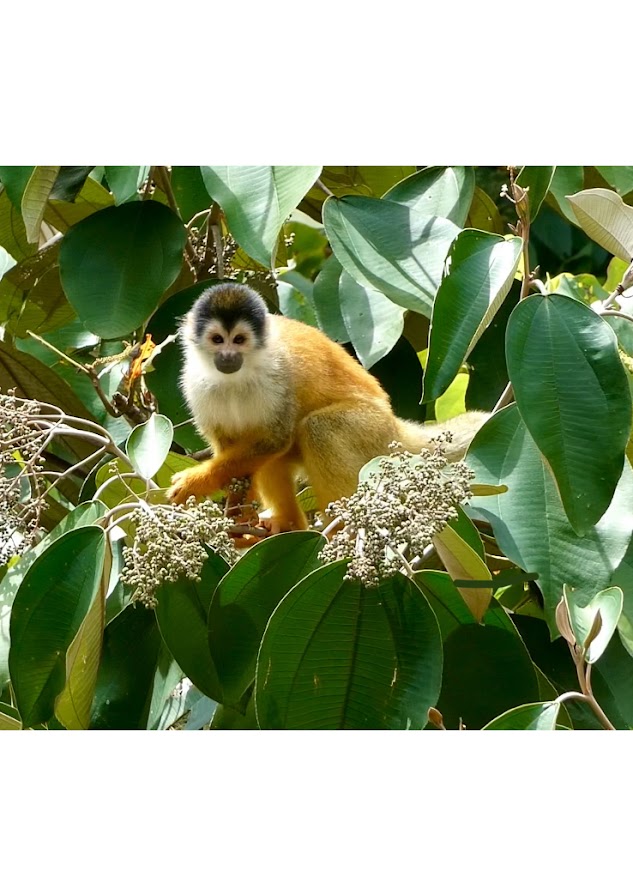
Weighing no more than 900g, squirrel monkeys are the smallest primate species to be found in Costa Rica. They also happen to be the most endangered.
For a small primate species, they have an incredibly long tail. At 15 inches, it is longer than their body length when fully grown. Unlike other primates in Costa Rica, the tail of the squirrel monkey is not prehensile and they cannot use it to hang from branches. However, the tail allows them to balance when running across vines and branches.
Highly energetic, squirrel monkeys spend at least 70% of the day foraging for food to keep up with their metabolic demand. Again, they are omnivorous. However, most of the diet consists of animal-based protein, in the form of insects and small vertebrates.
Squirrel monkeys live in large groups, ranging from 25 to 100 individuals. In rare cases, groups have been recorded at some 300 strong. To communicate in such large groups, squirrel monkeys have a variety of distinct vocalisations, postural displays, facial expressions and olfactory cues.
One of the most interesting forms of communicative behaviours is in the form of urine washing. This is not uncommon in the primate world, and can often be observed in capuchin monkeys. Monkeys will pee on themselves and spread the urine over their body. This allows other individuals from a group to pick up on olfactory information and may even regulate body temperatures.
Like spider monkeys, squirrel monkeys prefer areas of large, primary rainforest. Unfortunately, these requirements are hard to come by and, as a result, populations of squirrel monkeys are restricted to just a few national parks.
In the last 30 years, the population of Central American squirrel monkeys has plummeted. In fact, it is estimated that populations have declined by as much as 60%.
In Costa Rica, reasons for their declines can be attributed to habitat loss, retaliation killings by farmers, electrocutions from power cables, dog attacks and capture for the exotic pet trade.
However, Manuel Antonio and Corcovado National Park remain squirrel monkey hotspots. I have seen large troops in both areas.
Final Thoughts
In summary, Costa Rica’s monkeys are a vital part of the country’s rich biodiversity.
From the adaptable capuchin to the vocal howler, the agile spider monkey, and the endangered squirrel monkey, each species plays a unique role in the ecosystem.
Protecting their habitats and addressing threats is essential for ensuring that these fascinating animals continue to thrive in Costa Rica’s tropical forests.
In part two, we’ll be discussing some of the threats that face monkeys of Costa Rica.
 Cecropia Travel Blogs
Leave a comment